Heart Shaped Face: What It Looks Like and How to Tell
What a heart shaped face looks like, how to check yours with four measurements, how it differs from oval and diamond faces, and hair and glasses ideas.
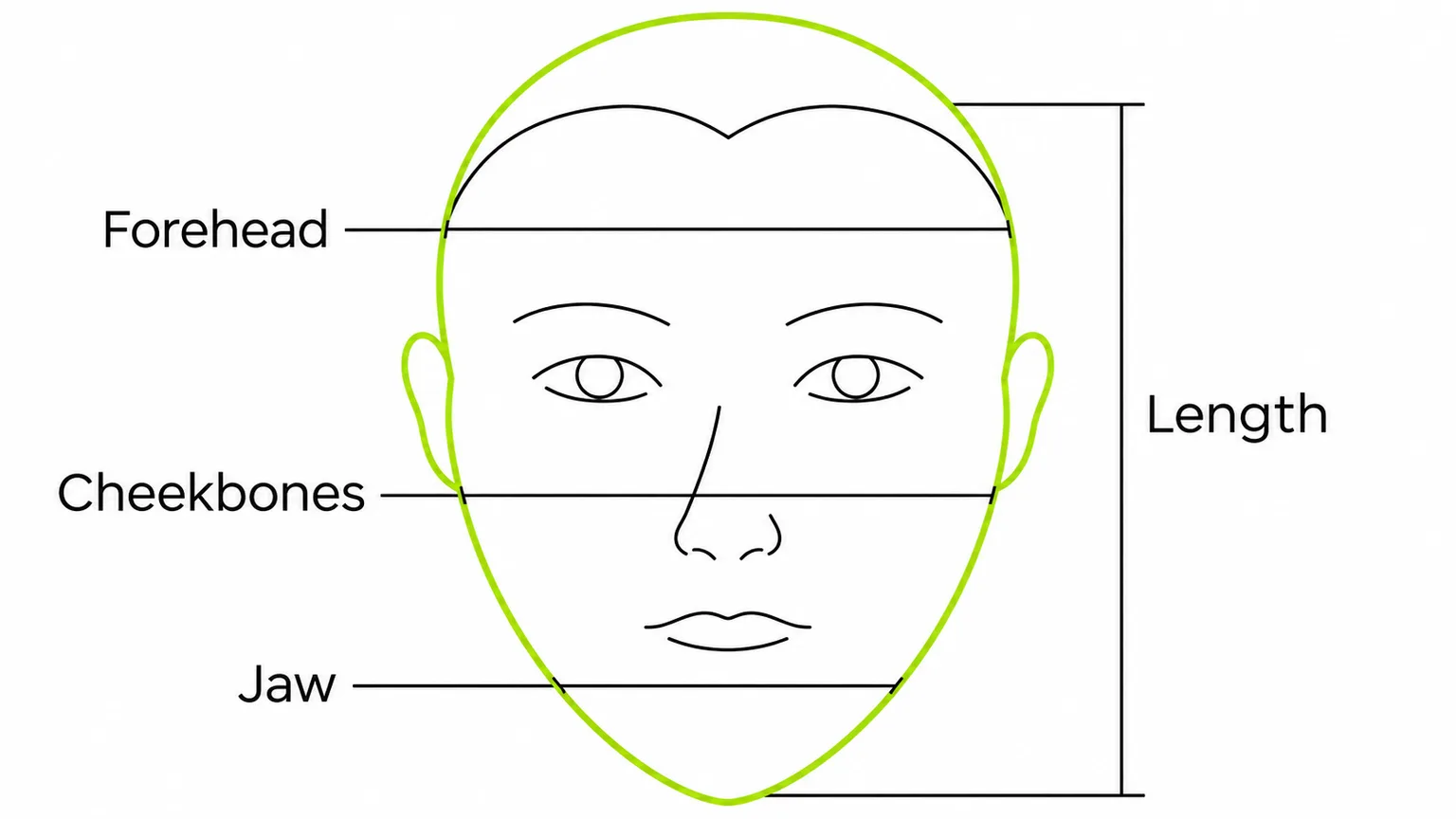
A heart shaped face is wider across the forehead and cheekbones and narrows to a smaller jaw and a slim or softly pointed chin. Seen from the front, the outline looks a little like an upside-down triangle with rounded corners. It is one of the common face-shape labels, and like all of them it is a quick way to describe proportions, not a rule about what you should wear.
What a heart shaped face looks like
These features usually appear together. You do not need all of them for the label to be useful.
- Broad upper face. The forehead is about as wide as the cheekbones, or slightly wider.
- Tapered lower face. The width drops noticeably from the cheekbones to the jaw.
- Narrow chin. The chin is slim and may come to a soft point.
- Moderate length. The face is a little longer than it is wide, but not as long as an oblong face.
- Sometimes a widow's peak. A V-shaped point in the hairline is often mentioned with heart faces, but plenty of heart-shaped faces have a straight hairline.
How to tell if you have a heart shaped face
You can check with a mirror and a soft tape measure, or a photo taken straight on at eye level with your hair pulled back.
- Forehead width: measure across the forehead at its widest point, roughly halfway between the eyebrows and the hairline.
- Cheekbone width: measure across the face at the most prominent point of the cheekbones, just below the outer corners of the eyes.
- Jaw width: measure from the angle of the jaw on one side to the same point on the other side, just below the ears.
- Face length: measure from the centre of the hairline straight down to the tip of the chin.
If the forehead and cheekbone widths are close, the jaw is clearly narrower than both, and the length is somewhat greater than the cheekbone width, the heart label fits well.
Turn your four numbers into ratios
Raw centimetres are hard to compare, so divide each measurement by your cheekbone width. The table shows the reference proportions behind the six outlines in our face shape chart. They are drawing references for each label, not averages from a population study, so use them to see which outline you are closest to rather than as pass or fail cut-offs.
| Shape | Length ÷ cheekbones | Forehead ÷ cheekbones | Jaw ÷ cheekbones |
|---|---|---|---|
| Heart | 1.40 | 1.03 | 0.66 |
| Oval | 1.50 | 0.88 | 0.78 |
| Diamond | 1.43 | 0.76 | 0.70 |
| Round | 1.08 | 0.90 | 0.84 |
| Square | 1.12 | 0.97 | 0.96 |
| Oblong | 1.78 | 0.92 | 0.85 |
Two numbers do most of the work for a heart face: a forehead ratio at or above about 1.0 and a jaw ratio near two thirds. No other outline combines a forehead that wide with a jaw that narrow.
Worked example. Say you measure a forehead of 13.4 cm, cheekbones of 13.0 cm, a jaw of 8.8 cm and a length of 18.3 cm. Dividing by 13.0 gives a forehead ratio of 1.03, a jaw ratio of 0.68 and a length ratio of 1.41, almost exactly the heart reference. Change only the forehead to 10.0 cm (ratio 0.77) and the same face matches the diamond reference instead, which is why the forehead is the measurement that separates the two. A tape measure on a curved face is never exact, so a difference of a few hundredths between two shapes is a tie, not an answer.
How the face shape detector decides on heart
The face shape detector does not use a tape measure. It finds facial landmarks in your photo and compares four measurements with six reference faces: oval, round, square, heart, oblong and diamond.
- Length to width: how long the face is compared with its widest point.
- Forehead to face width: how wide the forehead is compared with the cheekbones.
- Cheekbones to jaw: how much the face narrows from the cheekbones down to the jaw.
- Jaw angle: how sharp or soft the corner of the jaw is.
Length and the cheekbone-to-jaw taper count the most, the forehead slightly less and the jaw angle least. Among the six references, heart has both the widest forehead and the strongest taper to the jaw, which is why a broad forehead alone is not enough: the jaw has to narrow clearly as well.
The detector always reports the closest shape and the runner-up, and says when the two are close. A result of "heart, close to oval" is common and simply means your face sits between the two outlines. Photo landmarks and a tape measure also measure slightly different points, so the photo ratios are not the same numbers as the table above.
Heart vs oval, diamond and triangle faces
The four shapes below are easy to mix up because they differ mainly in where the widest point sits.
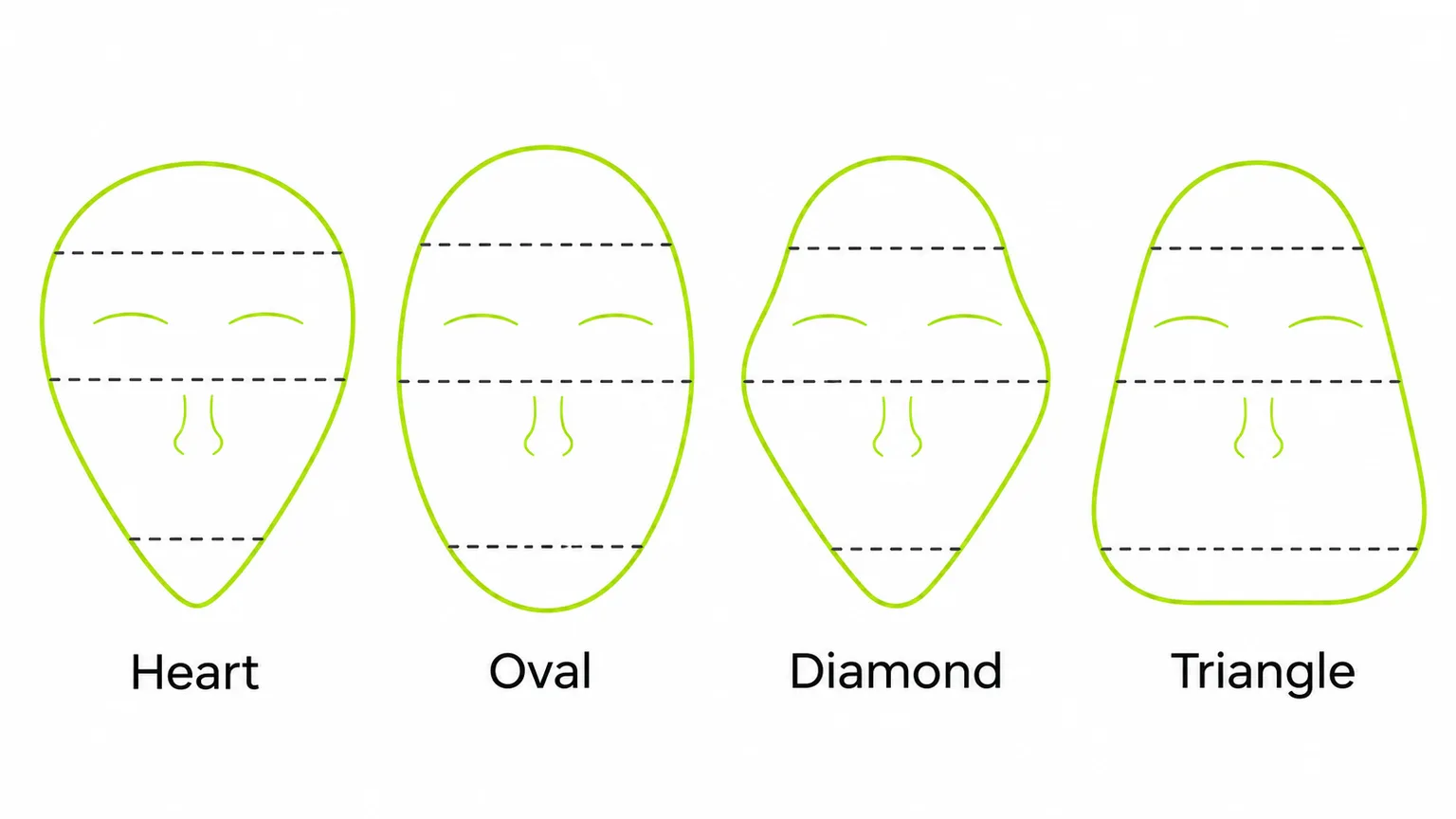
The dashed lines mark forehead, cheekbone and jaw width. On a heart face the top two are about equal and the jaw line is much shorter.
| Shape | Widest area | Jaw and chin | Length |
|---|---|---|---|
| Heart | Forehead and cheekbones, about equal | Clearly narrower jaw, slim or pointed chin | A little longer than wide |
| Oval | Cheekbones, with the forehead only slightly narrower | Jaw a little narrower than the forehead, rounded chin | About one and a half times the width |
| Diamond | Cheekbones only; forehead is noticeably narrower | Narrow jaw and chin | Longer than wide |
| Triangle | Jaw; the opposite of a heart | Broad jaw, forehead narrower | Varies |
Triangle is not one of the six shapes the detector reports. A face that is widest at the jaw usually comes out as square or round, depending on its length and jaw angle.
Heart shaped face vs oval face
This is the most common mix-up. Both have a jaw narrower than the forehead. The difference is how quickly the width falls away: an oval face narrows gradually and ends in a rounded chin, while a heart face keeps its width through the cheekbones and then tapers more sharply to a slimmer chin. If your forehead is noticeably wider than your jaw and your chin looks pointed rather than rounded, heart is usually the closer description. The oval face shape guide shows the oval outline in more detail.
Heart shaped face vs diamond face
Look at the forehead. On a diamond face the cheekbones stand out as the single widest point and the forehead is clearly narrower. On a heart face the forehead is about as wide as the cheekbones.
Heart shaped face in men
The shape is the same for everyone, but it often reads differently on men. Short haircuts show more of the forehead, so the broad upper face is more visible, and facial hair can hide or exaggerate the narrow chin. A heart-shaped male face typically has a broad forehead, high cheekbones and a slim chin, with a jaw that looks less angular than on a square face.
The ideas below are common ways to balance that outline. None of them are rules; they are simply options if you want the upper and lower face to look more even.
Haircuts for men with a heart shaped face
Because the forehead is the widest area, most suggestions avoid adding a lot of height or width on top.
- Textured fringe or crop: a fringe brushed forward covers part of the forehead and makes it look less broad.
- Side part with medium length: a side part breaks up the width of the forehead, and a little length over the ears adds visual weight lower down.
- Soft taper rather than a skin fade: keeping some hair at the sides near the ears helps the lower face look wider. A very tight fade with a tall quiff does the opposite and makes the top look heavier.
- Mid-length or swept-back styles: these work too, as long as the volume sits around the middle of the head rather than all on top.
Beard styles for a heart shaped face
A beard is the simplest way to add width to a narrow jaw and chin.
- Full or medium beard: kept fuller along the jaw and chin, it fills out the lower face and evens out the taper.
- Boxed or short boxed beard: a neat version of the same idea, with clean lines on the cheeks and density at the jaw.
- Heavy stubble: if you prefer a short look, a few days of growth softens a pointed chin without changing the outline much.
- Use care with pointed shapes: a long goatee or a beard trimmed to a point at the chin adds length to the narrowest part of the face and can exaggerate the taper.
Glasses for men with a heart shaped face
Frames that are lighter along the top and have some width at the bottom tend to balance a broad forehead. Thin metal or rimless frames, rounded rectangles and aviator shapes are frequent suggestions; very heavy browline frames draw more attention to the forehead. The glasses for heart shaped faces guide compares these side by side, and fit at the bridge and temples still matters more than the shape label.
Hairstyle and glasses ideas
Styling ideas for heart faces usually play with the contrast between the broad upper face and the narrow chin.
- Hair: chin-length bobs, side parts, curtain bangs and layers that add movement around the jaw are common starting points. Our hairstyles for heart shaped faces guide compares these with simple sketches and the questions to ask a stylist.
- Bangs: a fringe covers part of the broad forehead, so it is one of the most common suggestions for heart faces. Whether it suits you also depends on how tall your forehead is; the should I get bangs check measures your forehead share from a photo and ranks curtain, side-swept, wispy and blunt bangs.
- Glasses: frames that are light along the top edge, rounded or oval lenses, and rimless or thin metal styles are frequent suggestions. See glasses for heart shaped faces for a side-by-side comparison; correct fit across the nose and temples always matters more than the shape label.
FAQ
Is a heart shaped face rare? There is no reliable count of how many people have each face shape, partly because different guides draw the boundaries differently. Heart is generally described as one of the less common labels compared with oval and round, but many faces sit between two shapes.
Can you have a heart shaped face without a widow's peak? Yes. A widow's peak is a hairline feature, not part of the face outline. Many heart-shaped faces have a straight or rounded hairline.
Does a heart shaped face change with age? Face proportions can shift over the years as soft tissue changes, so the label that fits best at 20 may fit less well at 50. Measuring again from a recent photo is the simplest way to check.
What is the difference between a heart face and an inverted triangle face? They describe almost the same outline. Some guides use "inverted triangle" for a sharper, more angular taper and "heart" for a softer one with a rounded hairline.
Is a heart shaped face attractive? Face shape on its own does not decide attractiveness. The label is useful for choosing haircuts and frames, not for ranking faces.
Check your face shape
If your ratios land between heart, oval and diamond, a photo check settles it faster than a tape measure.